
Stories from Fransen/King and the HP 3000 era.

Office Extend

The competition should have been daunting. Microsoft, Novelle, and 3Com offered expensive networking solutions to connect PCs to share printers and files. These systems typically cost $1,000 per PC, required expensive cable installations, and a small army of technicians to support them.

Reading through the technical manual for his new PC, Craig found that the contents of the entire BIOS, the most central hardwired core of PC functionality, was listed at the back of the manual. In it, including comments, was the code for serial communication, and clues to how network interception of DOS functionality could be used to implement his own network.

Combining this with clues provided by Marty Quinn, of WRQ in Seattle, Craig was able to bring up a prototype of a print interceptor which could talk to an HP3000. Serial RS-232 communication was the standard way terminals were connected, and PCs in HP3000 customer offices were often connected with inexpensive serial boards to the HP to double as terminals.

Craig had years of experience coding SPL, the systems programming language of the HP and quickly created an endpoint that could talk to his intercept prototype.

It worked! Craig ran a word processor on his PC (WordPerfect no doubt), prepared a document, then printed it to the virtual printer he had created. The output appeared on the spooled LaserJet perfectly.

After the prototype was converted into a product with pop-up configuration, user manual, and delivered to customers through a bootstrapped upload from floppy disk, the Office Extend Print Connection product went to market.

It was priced at $95 / PC, less than 10% of an equivalent network set up.

Fransen/King went on to provide disk / file sharing in a similar manner, eventually including a tape backup utility that backed up multiple PCs simultaneously to the HP3000 tape drive, and a reverse pathway for HP3000 application output to print on printers directly attached to PCs.


The Fransen/King Origin Story

Jeff King worked for Peat, Marwick, and Mitchell in Seattle as a tax attorney. One day, he came to Craig Fransen (a friend from college) with a problem. Jeff had thought of a way to help clients using Section 6166 of the US Tax Code to properly calculate interest on the fifteen year sequence of payments that allow people with closely held estates to pay estate tax in installments. Craig created a program that used an iterative algorithm to zero in on optimal answers.

Peat Marwick was impressed and offered to buy a brand new IBM PC (the original) to allow Craig to continue the work. The result become a valuable service offered by Peat.

With that success, in 1986 Craig and Jeff decided to leave their current jobs and form Fransen/King, Ltd.

Jeff continued to offer tax consulting while Craig concentrated on the creation of a series of products in the Hewlett-Packard 3000 market.

FAX/3000

FAX/3000

Hewlett-Packard invented the LaserJet. Using Office Extend Print Connection and later the Serial Network, HP3000 customers could share those expensive printers with everybody in the office using simple RS-232 terminal connections.

Before the ubiquity of the Internet, faxing was a thing. A big thing. Companies wanted an ability to send faxes out automatically from HP3000 applications.

Office Extend already offered an ability for HP3000 applications to route output to PC-attached printers, valued for remote offices, custom PC attached printers and similar situations. Starting with this capability, Fransen/King designed a fax server which ran on a PC, got output from the HP3000, and converted it to the TIFF format necessary for faxing. It interpreted metadata supplied with the output to glean phone numbers, attention lines, etc., and utilized PC-installed fax boards to transmit the messages. Success and failure signals (after retries) were reported back to the host computer.

This worked well for "green bar" pages, but many applications were designed to use pre-printed forms that were loaded into the line printers to produce invoices, etc. HP3000 applications from vendors such as SMM in London were able to reproduce those form on LaserJets using proportional downloadable fonts, graphics, and all the other features available on the LaserJet. The problem was how to fax them.

Fransen/King went to work and developed a PCL interpreter (the LaserJet format) which could convert the data and LaserJet "escape" sequences necessary to produce perfect TIFF images, exact copies of what would have appeared on paper. Working entirely from a PCL manual, this involved thousands of lines of 8086 assembler code to fit this logic into the 512K available on the PC. This also had to include a way to cache portions of the image before transmission, which itself could be megabytes. The developed library supported all features of PCL (including a number of undocumented ones!) and could convert at a rate of 30 pages per second.

The FAX/3000 system gained customers around the world, many were large HP3000 customer organizations, such as WestJet, Bank of New York, Driscoll Strawberries, a number of European companies through Fransen/King's partner in London, SMM Ltd, and in Australia, with Vanguard Computer Systems.

Expeditors International

In the late ’80s, Expeditors was a Seattle company led by Peter Rose and a team of former Harper Group executives who left to build a new vision for international freight forwarding. A number of former Peat Marwick employees also joined the effort.

Expeditors offered a single-source for air and ocean freight as well as combined customs brokerage, unique in the industry. They started small and were supported by an IT department of 10.

Jeff King's Peat Marwick friends at the company offered Craig a consulting gig. This grew into an ongoing relationship as Expeditors exploded in size and Fransen/King, Ltd. found a ready customer for a number of products.

Craig had recently created a fax system which could route traffic directly from HP3000 applications. But Expeditors had a different problem.

Every Expeditors shipment crossed international borders, usually oceans. To notify the destination office of a shipment, the origin sent a fax with information and a copy of the commercial invoice for customs clearance. International telephone rates at that time ran $5.00 per minute. A fax could easily consume a few minutes.

Craig envisioned an enhancement to the fax product that would utilize a network if available. Pre-internet, companies created networks by leasing full-time telephone lines, an expensive proposition, and one Expeditors had not pursued. However, Craig and Dave Lincoln, IS Manager of Expeditors, penciled out a solution. Expeditors could afford to put leased lines in to several remote offices solely on the savings of replacing those fax transmissions.

Now operators in Hong Kong, for example, could scan piles of paper and they would appear at the destination office faster than any fax.

In addition, the fax system could use a network for part of the journey so that an Asian office could fax traffic to customers in the US by first moving the images to Expeditors in Seattle, then sending them out with domestic phone rates.

The Fax/3000 system gained a number of customers around the world, large customers with HP3000 installations, such as WestJet, Bank of New York, Driscoll Berries, a number of European companies through Fransen/King's partner in London, SMM Ltd, and in Australia, with Vanguard Computer Systems.

Expeditors later came to leverage its dependable world-wide leased line network and it has become a critical part of its business as it has grown to Fortune 500 size.

The First Floppy Delivery

The first HP3000 software delivered on floppy disks

$19 Show Special

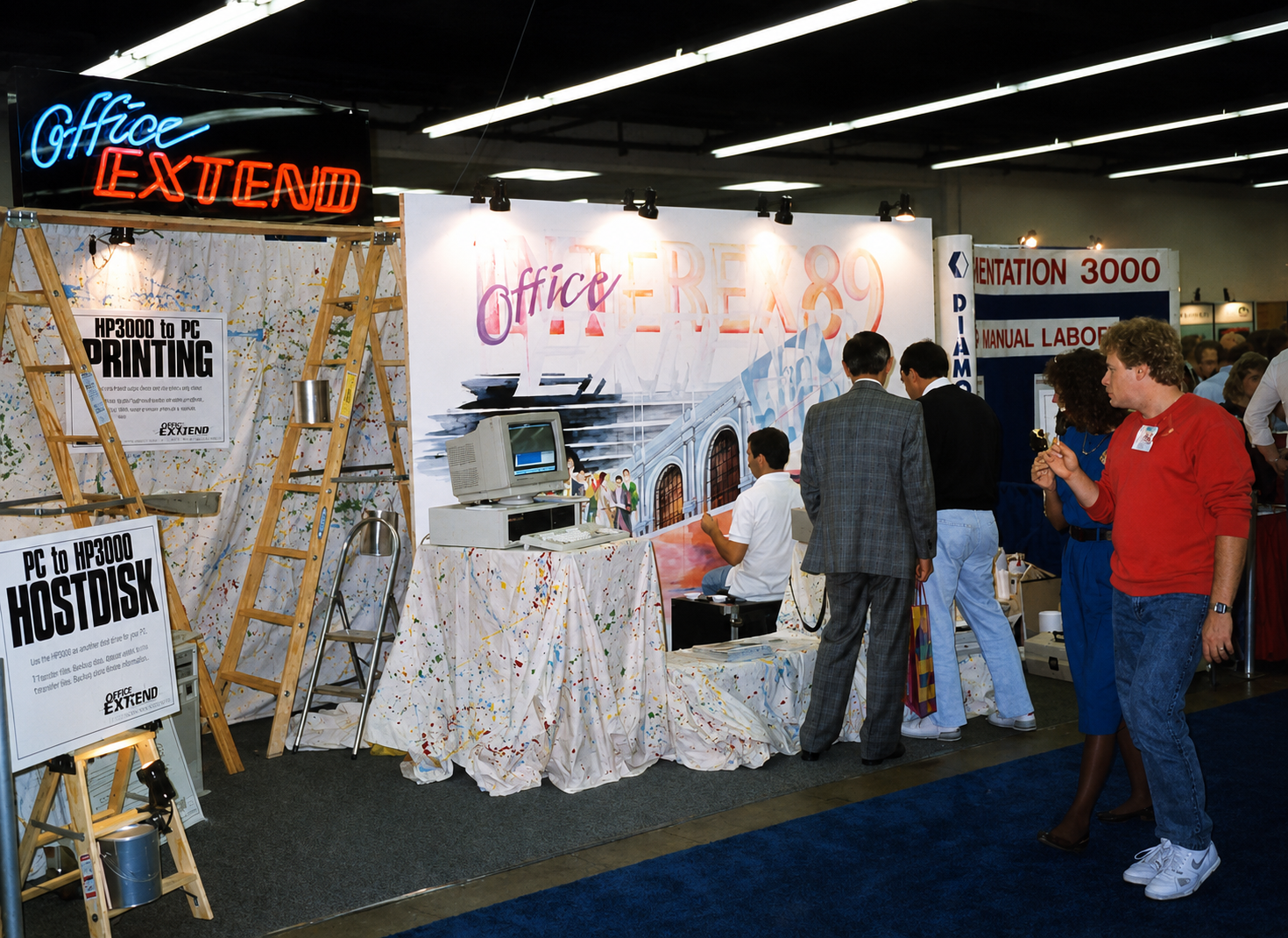
Booth location was always key to a successful Interex convention, the big show for hundreds of HP3000 vendors. Being near the entrance door was a coveted position for the companies. Booth sites were allocated by seniority, so in our early days, Fransen/King had to make the best of booth locations on less stellar sections of the floor.

In 1989, we had budgeted a 20' space, quite a step up. But the best we could do location-wise, although in the front, was over in one corner of the floor. The main door was in the middle.

Our pitch that year was a $19 Show Special–a full copy of OfficeExtend, normally $95. Traffic was decent, not spectacular, but then, wonder of wonders, they opened a door to the convention floor right in front of us! The bank card swiper began smoking.

"I don't know what you're selling, but for $19, I'll take a copy", one customer reported.

We sold enough packages to pay for our entire show and introduced hundreds of new customers to the product (and with the help of Jordan Gates, a future President of Expeditors manning the booth with us).

Our Own Leroy Neiman

Every year, we spent time coming up with the year's killer booth theme–something guaranteed to pull customers in. In 1989, we envisioned Leroy Neiman in the booth creating an image of the trade show excitement.

We couldn't afford Leroy, so we enlisted our graphics designer to fill in. That year's show was a success and we supplied copies of the painting to customers.

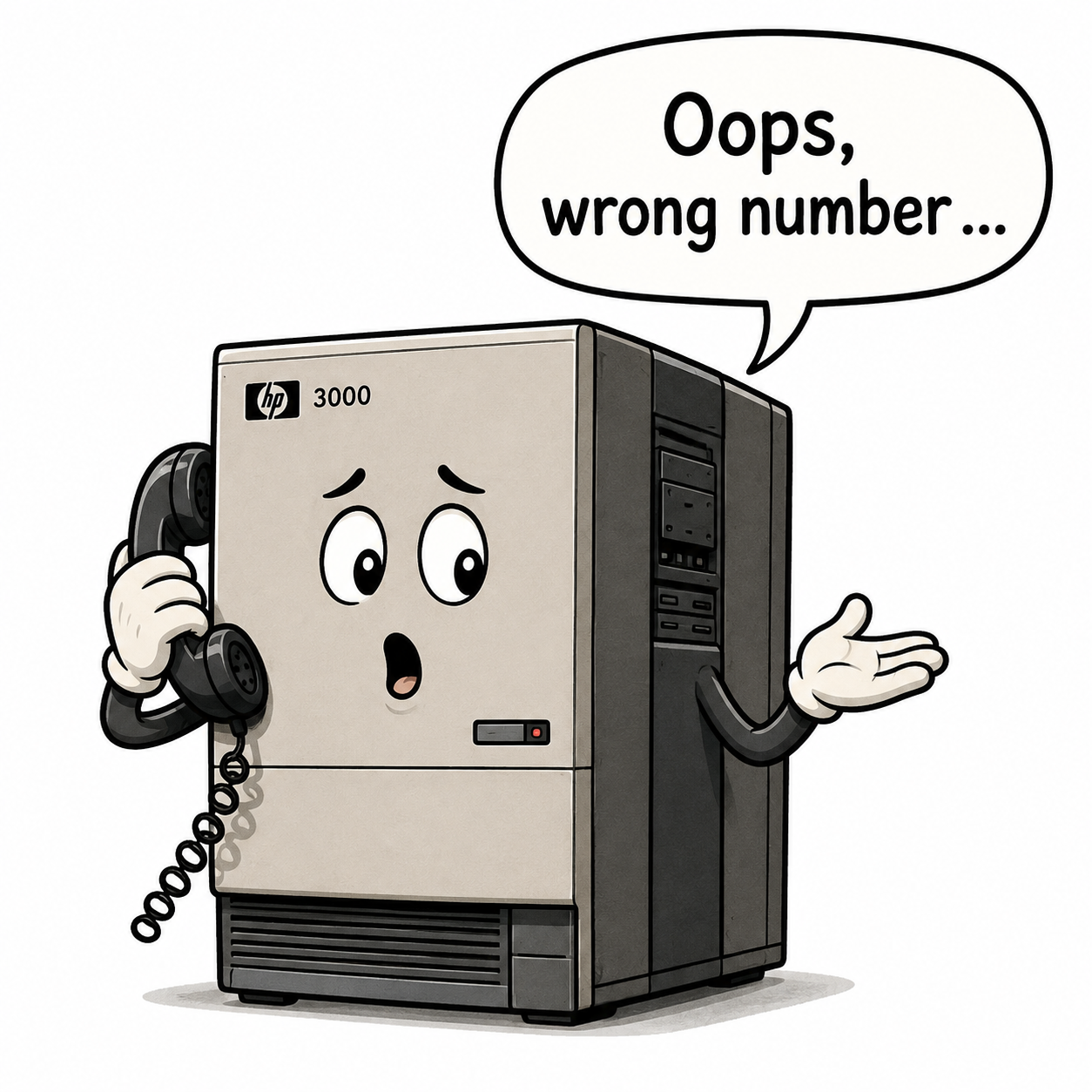
Sorry, Wrong Number

The FAX/3000 system was designed to robustly retry failed connections. It used an incremental back-off timer to retry failed calls after one minute, then two, then four, eight, etc. until the configured retry limit was exhausted.

A certain unnamed customer misconfigured a fax number for an invoice to be sent from his HP3000 application. The recipient was in South Africa and due to timezone differences, the fax was attempted at 2AM Africa time.

The misconfigured number turned out to instead be the home telephone number of a chap who normally was asleep at his 2AM local time. But his phone rang. When he picked it up, a fax modem screeched at him. He hung up. A minute later, it rang again. He hung up again. Two minutes, ring. Four minutes, ring. Eight minutes, ring, and then blessed quiet.

But unfortunately, that was not the end of the story. The next night the same ordeal repeated itself. And the next night. And the next. But he recognized the screech as a fax machine.

His solution? Yep. Buy a fax machine. He hooked it up, received the fax and read it. He discovered the sender, called the company and no doubt very calmly explained the situation.